opl-env
Screenshots
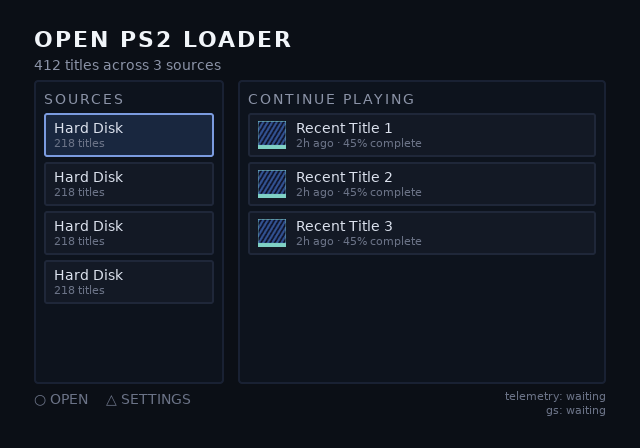
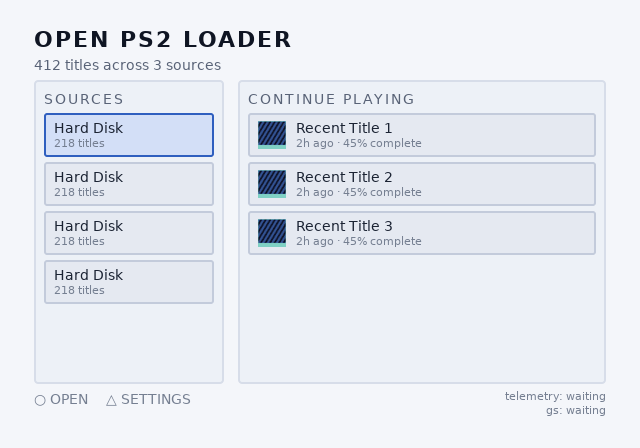
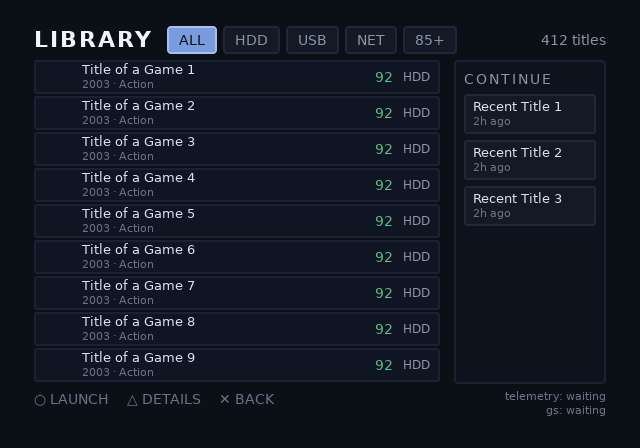
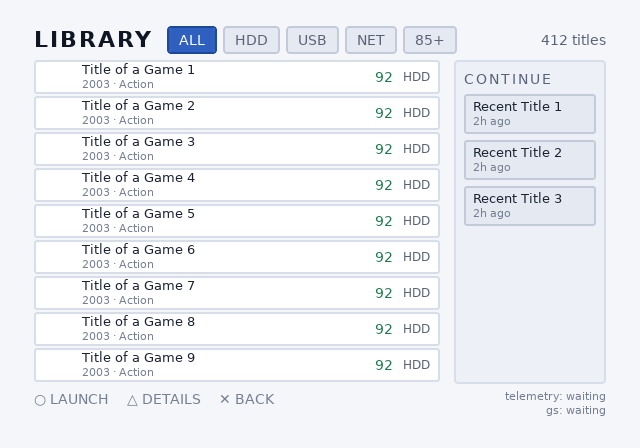
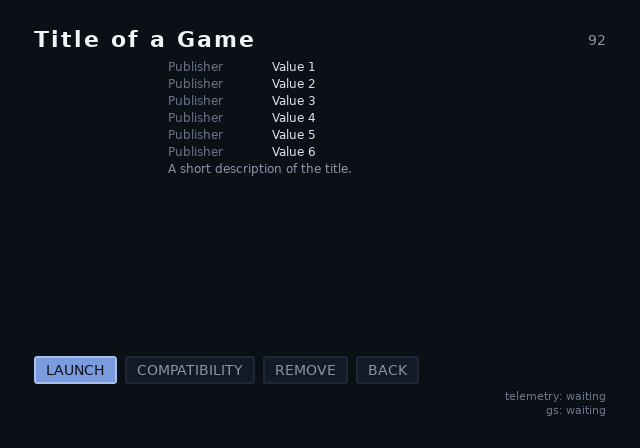
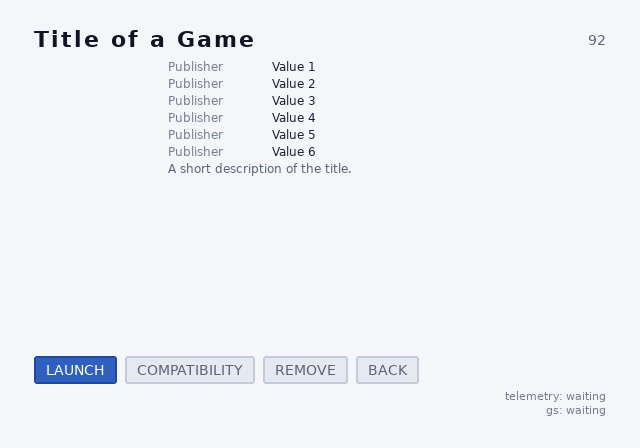
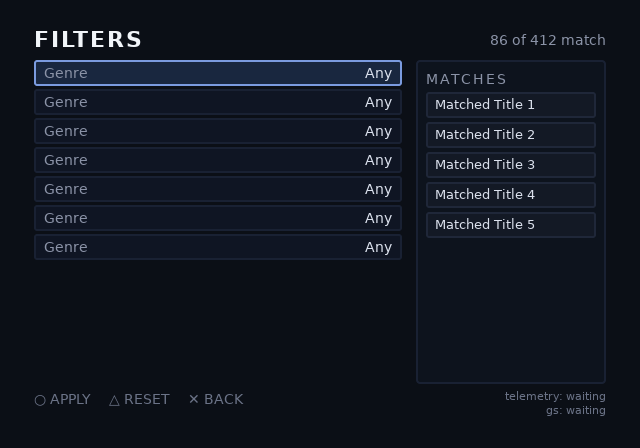
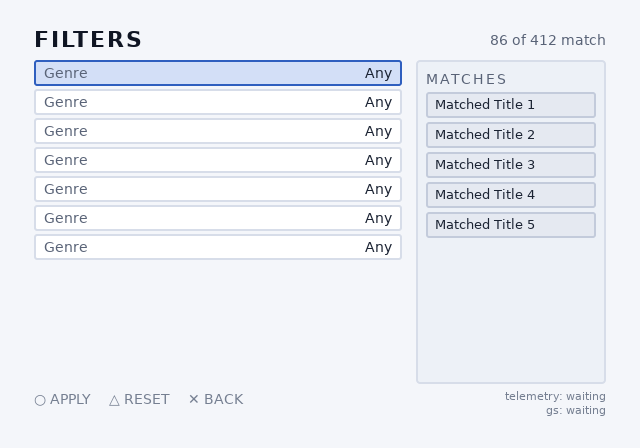
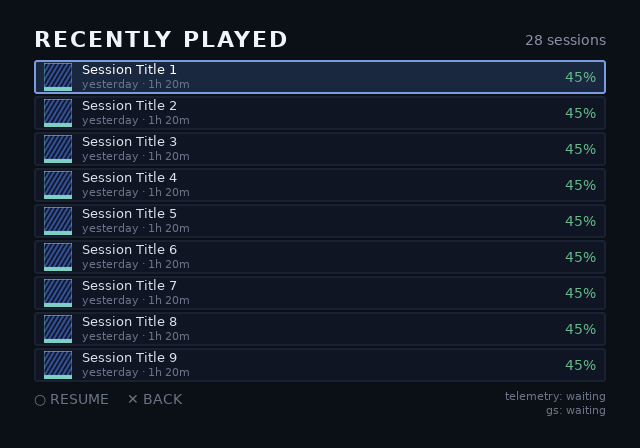
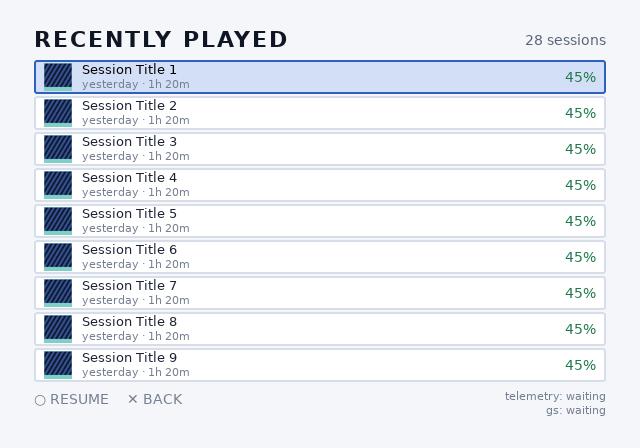
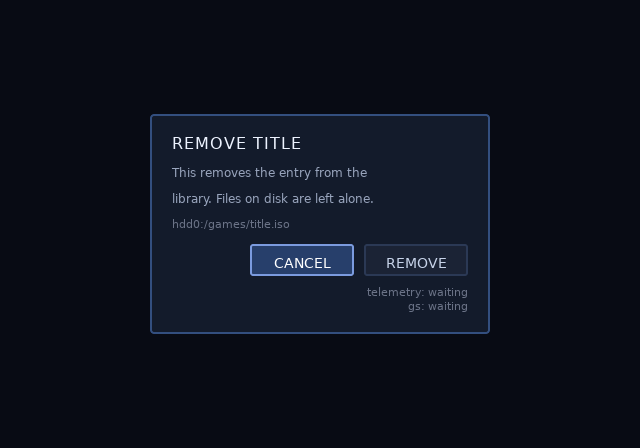
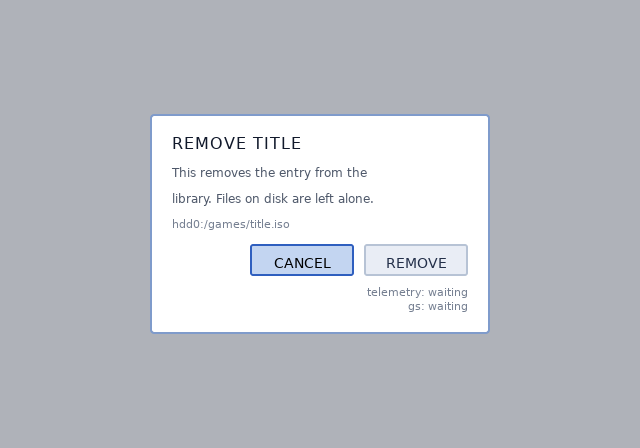
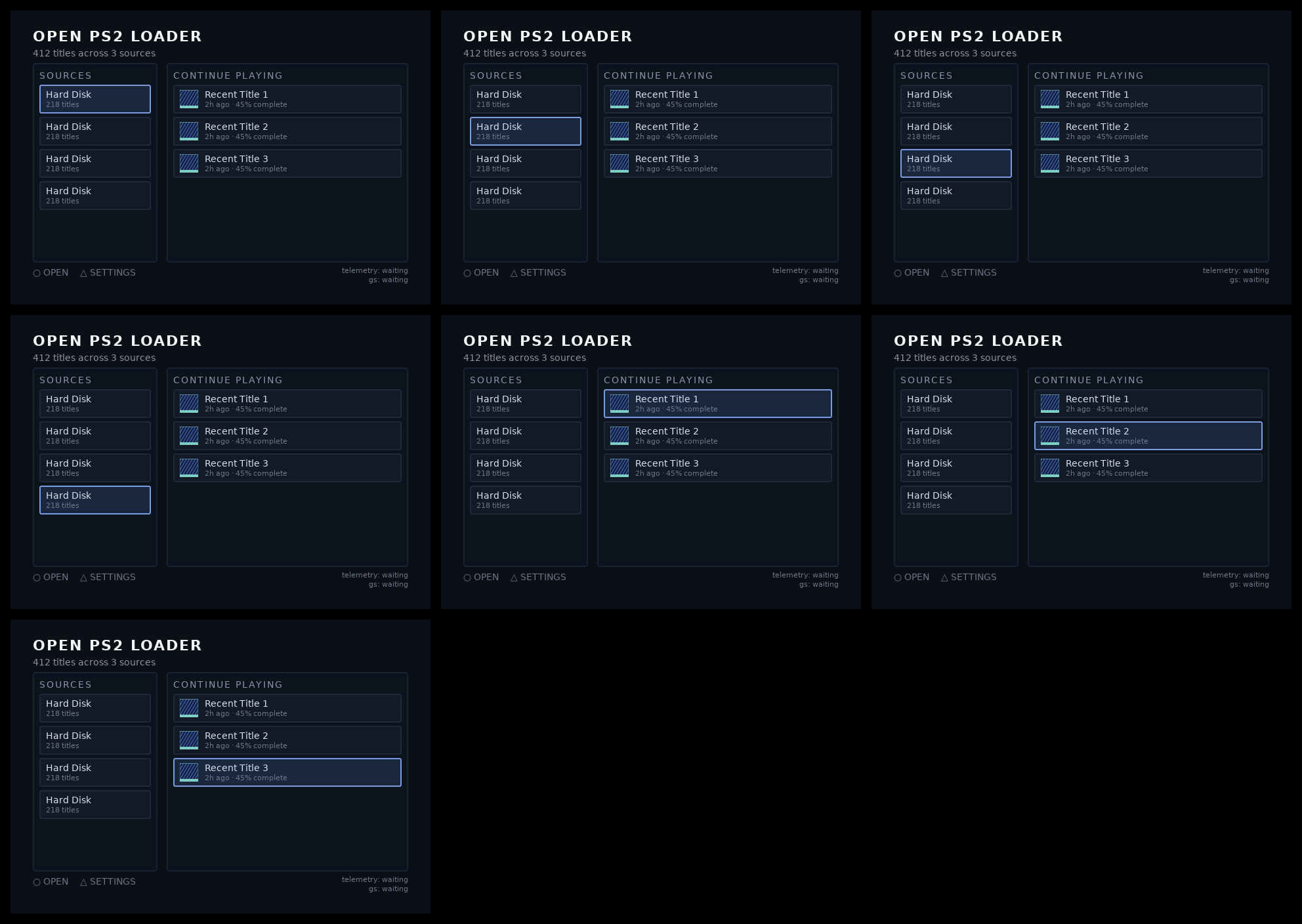
Every streamed slot renders empty here. ps2ui_upload leaves an unfilled
reservation's texture pointer null, and ps2ui_render skips the textured
draw on the same test. A driver fills each one as the corresponding row or
cover scrolls into view.
What it demonstrates
opl-env bakes six screens into one blob: landing, library, detail, filters, recent and confirm, sharing one stylesheet and carrying two themes and 137 runtime-editable slots between them. It exercises the same mechanisms memcard does, plus three memcard has none of: a themed palette, streamed cover art and an overlay screen.
| mechanism | where |
|---|---|
One project file compiles six screens against one shared stylesheet, --strict and an 11px slot-text floor |
ps2ui.json |
data-tex-slot reserves a streamed texture: nine 28x28 library-row covers and one 120x72 detail cover |
library.html, detail.html |
confirm is a separate screen composited over library or detail, with no clear between the two renders |
confirm.html |
:root plus one @theme light block gives every named colour a second value |
opl.css, opl.css |
data-repeat writes out the repeated rows, tiles and fields: nine library rows, six detail fields, seven filter facets, three landing resume cards |
library.html, detail.html |
data-slot on every screen for a two-line driver telemetry readout, named per screen |
library.html |
| A host-side windowed list keeps nine fixed streamed reservations pointed at a scrolling selection | window.h |
The project file names six screens and sets strict and minFontSize; it
leaves mode, canvas, displayAspect, focusWrap, palettizeImages and
vramBudget at the baker's default. Read the full key table on
the project file. Two named
theme rows are the mechanism theming
covers; the streamed row and detail covers are what
streaming art covers; confirm
composited over the base screen is what
screens and overlays
covers; the repeated library rows, facets and tiles are the pattern
lists covers, though opl-env writes every
row out at build time rather than through a runtime scrolling window.
Build and check
Run the example's own script from the repository root:
The script compiles all six screens, bakes them into one blob, runs
ps2ui-check through tools/check-blobs.sh,
runs the example's own check.py against the fresh blob, then re-renders the
twelve committed per-theme screenshots. Its last lines:
1..93
PASS: 93 checks, 0 failure(s)
ps2ui-bake: screenshots (2 theme(s)) -> ./examples/opl-env/screenshots/
opl-env example: ./examples/opl-env/build/ui.uib
build.sh's header comment says it runs the host runtime tests. It runs
ps2ui build, check-blobs.sh and check.py; none of the three calls
make -C runtime test.
The screenshots this run just wrote match the ones already committed:
tools/check-blobs.sh checks this blob with --strict alone, no
--allow-dead or --allow-hairline:
Validate the blob's numbers directly with ps2ui-check:
$ ps2ui-check examples/opl-env/build/ui.uib
...
1..107
# examples/opl-env/build/ui.uib: 640x448 at 4:3, 6 screen(s), 2158 commands, 21 textures, 137 slots
PASS: 107 checks, 0 error(s), 0 warning(s)
The example's own check.py reads the same bytes and asserts the theming
contract a format-level check cannot see: the tint table is role-keyed, slot
text and commands share the entries their names share, and every screen
carries a fitting telemetry pair. It runs from build.sh, against a build
artefact, rather than from the baker's unit suite.
The figures in README.md match the blob:
$ python3 tools/check-example-figures.py
ok - opl-env: 7 of 7 documented figures match the blob
ok - docs/PLAN.md's 4 restated figures match too
CI builds and checks this blob in the step named "OPL environment end to
end", which runs ./examples/opl-env/build.sh and nothing else. Two later
steps depend on that build: "Example figures match their blobs" runs
tools/check-example-figures.py, and "Committed screenshots match the
renderer" re-runs the git diff --exit-code above across all three
examples' screenshot directories together.
Numbers from the blob
Taken from the ps2ui-check trailer and arena note above, and from the
texture and VRAM lines ps2ui-bake prints while baking, both from the same
build.sh run. See the arena note
for why the EE and host figures differ.
| field | value |
|---|---|
| canvas | 640x448 at 4:3 |
| screens | 6 |
| commands | 2158 |
| textures | 21 (10 streamed, 11 baked) |
| CLUTs | 2 |
| slots | 137 |
| focus nodes | 51 |
| fonts | 6 |
| themes | 2 |
| arena, EE | 7319 bytes |
| arena, 64-bit host | 7487 bytes |
| blob size | 269,824 bytes |
| VRAM used | 336 KiB of 736 KiB budget (45%) |
Source tour
- ps2ui.json - the whole project: six
screens, one stylesheet,
--strict, an 11px floor and a preview and montage path. - ui/library.html - the busiest screen: nine streamed rows, five filter chips, three continue-playing tiles and its own telemetry pair.
- ui/confirm.html - the overlay screen: a two-line body split across two slots, and the comment on why composition never clears.
- ui/opl.css - the shared stylesheet:
every named colour in
:root, the second value in@theme light. - window.h - the host-side windowed list: C89, no PS2 headers, the mechanism a scrolling library needs on top of fixed reservations.
- check.py - the blob-level theming contract: role-keyed tints, the identity entry and the per-screen telemetry fit.
Start from this
Copy the six-screens-one-stylesheet project shape with strict and
minFontSize set, the :root plus @theme pair for a second palette, the
data-tex-slot pattern for art that arrives at runtime, and the per-screen
telemetry slot pair for a readout that costs nothing when unset. Copy the
two-slot split for any text that runs past one line; a single data-slot
never wraps.
Replace the six screens and their data-repeat counts with your own,
replace the streamed slot names and sizes with the art your environment
actually loads, and replace the driver's telemetry format strings with
whatever your own build wants measured. window.h's per-row reservation
model is a starting point, not a mandate: it windows by row and reuploads
every visible row on any scroll, which is the cost the file exists to make
visible before anything optimises it.
After the blob passes ps2ui-check, the first-boot checklist is what takes it from a host build to a console frame.