Theming
A theme is a second value for every named colour. One blob carries every theme, and the console selects one by index.
What it is
Give a colour a name in :root. Give that name another value in an @theme block. Read the name at a use site with var(). The compiler resolves each name into a vector of one colour per theme. The baker interns those vectors into the tint table, and every painting command and every slot stores an index into it. ps2ui_theme_set moves which row of that table is live.
A theme moves colour and nothing else. Both rows share one baked layout, so no geometry reflows and no texture is re-uploaded. Names exist at build time only. The blob stores a row count, the runtime selects by index, and no var() name is written into the file. The tint entry is the record it selects.
These two pictures are the same screen of the same blob, row 0 and row 1:
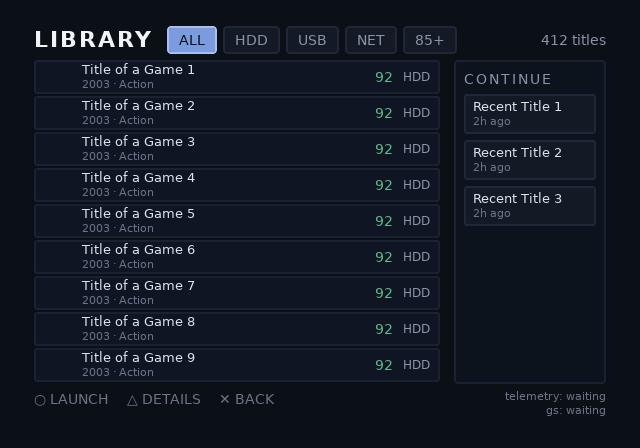
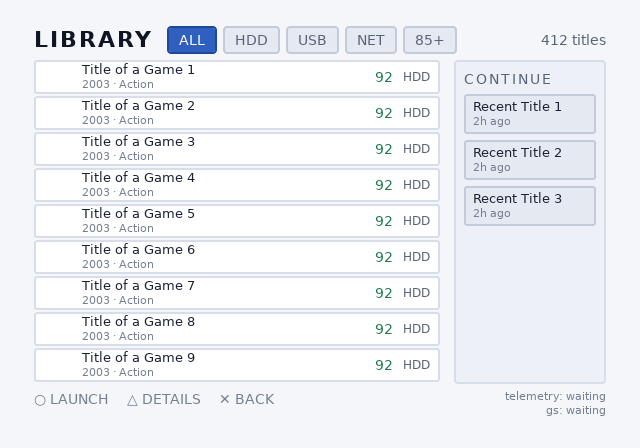
The reasoning behind role keying is in the design document listed on Internals.
Minimal example
Two names, one alternative theme, one rule:
:root        { --panel: #12182a; --ink: #dde3f0 }
@theme light { --panel: #ffffff; --ink: #1a2033 }

.row { background: var(--panel); color: var(--ink); padding: 32px }
Compile it against <ui><div class="row">Library</div></ui>:
$ ps2ui-layout theme.html theme.css --fonts fonts/fonts.json -o theme.json
ps2ui-layout: 2 paint commands, 0 focusables -> theme.json
The IR names the themes in index order and gives every colour a vector of that width:
$ python3 -c "
import json; d = json.load(open('theme.json'))
print(d['themes'])
print(d['commands'][0]['fillVar'], d['commands'][0]['fillThemes'])
print(d['commands'][1]['colorVar'], d['commands'][1]['colorThemes'])"
['root', 'light']
--panel [[18, 24, 42, 255], [255, 255, 255, 255]]
--ink [[221, 227, 240, 255], [26, 32, 51, 255]]
Baking it writes two rows of two entries:
$ ps2ui-bake theme.json -o theme.uib --fonts fonts/fonts.json --tints
...
# 2 tint entries over 2 theme(s): root, light
    0  ( 18, 24, 42,128)  (255,255,255,128)  --panel
    1  (111,114,120,128)  ( 13, 16, 26,128)  --ink
ps2ui-bake: 1 screen(s), 8 records, 1 textures (16 KiB baked), 1 CLUTs -> theme.uib
Reference table
| syntax | effect |
|---|---|
:root { --name: <color> } |
Defines --name and gives it theme 0's value. The only definition site. The value must be a colour. |
@theme <ident> { --name: <color> } |
Adds one theme, in source order, starting at index 1. Sets the value a name takes in that theme. Custom properties only. |
var(--name) |
Reads a name at a use site. The whole declaration value, with one exception below. No fallback, and an undefined name is an error. |
border: <n>px solid var(--name) |
The one place a var() sits beside other tokens. Sets a themed border colour. |
| a colour literal | One entry, the same colour in every theme. No theme can move it. In a sheet that declares a theme it warns. |
an ordinary property in :root |
Ignored, with a warning. There is no root cascade on this target. |
a custom property outside :root |
Ignored, with a warning. Names resolve globally. |
Which colour spellings parse is on CSS. A name holding anything else is refused at the definition:
$ ps2ui-layout theme.html gap.css --fonts fonts/fonts.json -o out-gap.json
error: css: line 1: --gap: "4px" is not a color, and ps2ui custom properties are colors only -- geometry is baked, so a themeable length would be a different and much larger design
Behaviour
Roles, not values
A tint entry is keyed on the var() name together with the whole vector behind it. One name used at many sites is one entry. Two names holding the same colour stay two entries, because a theme has to be able to move one and not the other. Two literals that agree collapse, but never into a named entry.
examples/opl-env/ui/opl.css defines its palette once and writes var(--accent) at nine sites:
Those nine are entry 8 of a 28-entry table:
$ ps2ui-bake landing.json library.json detail.json filters.json recent.json confirm.json -o opl.uib --tints
...
# 28 tint entries over 2 theme(s): root, light
    0  ( 11, 15, 22,128)  (244,246,250,128)  --bg-page
...
    8  ( 62, 78,112,128)  ( 24, 48, 96,128)  --accent
    9  (128,128,128,128)  (128,128,128,128)  (literal, unthemed)   FIXED in every theme
...
   21  (128,128,128,128)  (  0,  0,  0,128)  --ink-max
Entries 9 and 21 hold the same colour in row 0 and different colours in row 1. Value keying would have fused them, and moving --ink-max would have recoloured every untinted nine-patch.
Once a sheet declares a theme, a colour written at a use site warns once per authored line:
$ ps2ui-layout theme.html literal.css --fonts fonts/fonts.json -o out-literal.json
warning: css: line 3: color: "#8b94a7" is a literal in a sheet that declares a theme, so no theme can move it -- name it in :root, or leave it if staying fixed is deliberate
ps2ui-layout: 2 paint commands, 0 focusables -> out-literal.json
A sheet with no @theme block never warns about a literal. Leaving a colour unnamed is a choice, and the warning fires only where a theme could have reached it.
Colour lives in two tables. Slot base and focus colours intern through the same key, so a theme reaches dynamic text as well as panels. See dynamic text.
Opacity splits a role
opacity folds into alpha before the key is formed. One name at two opacities is two painted colours, so it is two entries:
$ ps2ui-bake op.json -o op.uib --fonts fonts/fonts.json --tints
...
# 3 tint entries over 2 theme(s): root, light
    0  ( 51,102,153,128)  (238,238,238,128)  --panel
    1  (111,114,120,128)  ( 13, 16, 26,128)  --ink
    2  ( 51,102,153, 64)  (238,238,238, 64)  --panel
The fold runs over every row, so no theme is left at full alpha.
Lints run per theme
The linter runs once per theme. Colour lints are reported for every row that fails, and a lint from a later row is prefixed with its theme name. Geometry lints are reported once. A theme whose ink stays dark fails contrast in that row alone:
$ ps2ui-layout theme.html omitted.css --fonts fonts/fonts.json -o out-omitted.json
warning: css: line 2: @theme light does not set --ink (defined at line 1), so it keeps the :root value -- a theme that covers some of the palette recolours some of the screen
warning: @theme light: contrast: "Library" contrast 1.29:1 < 3:1 — CRTs crush shadows harder than your monitor
ps2ui-layout: 2 paint commands, 0 focusables -> out-omitted.json
Run with --strict to make both warnings an exit 1. See the CRT linter.
Seeing each theme
Four views, in build order. ps2ui-bake --tints prints the table as it writes it, with the var() name behind each entry. An entry no theme moves is marked FIXED in every theme. ps2ui-check --tints prints what a loader finds: no names, and a where column naming the commands and slots that point at each entry. Run both; each answers half of "why did this not change colour".
$ ps2ui-check --tints examples/opl-env/build/ui.uib
# 28 tint entries over 2 theme(s)
  idx  theme 0               theme 1               where
    0  ( 11, 15, 22,128)     (244,246,250,128)     cmd
    1  (121,123,125,128)     (  8, 11, 18,128)     cmd, slot
...
    9  (128,128,128,128)     (128,128,128,128)     cmd, fixed in every theme
The flags are documented on ps2ui-bake and ps2ui-check.
For pictures, preview.render takes a row number. ps2ui-bake --preview renders row 0 only, so render the others directly:
$ PYTHONPATH=packages/baker python3 -c "from ps2ui_bake.uib import read_uib; from ps2ui_bake import preview; preview.render(read_uib('examples/opl-env/build/ui.uib'), screen='library', theme=1).save('docs/site/assets/authoring/theming/library-theme-1.png')"
examples/opl-env/build.sh loops over range(len(uib.themes)) and writes one set per row. The previewer carries a Theme control, disabled below two themes, and a --theme option that opens on a chosen row.
Runtime
ps2ui_theme_set(ctx, n) selects row n. It takes no GSGLOBAL, touches no texture state and schedules no transfer. It takes effect on the next ps2ui_render. Call it before or after ps2ui_upload; it survives an upload, which a CLUT swap does not. A row at or past n_theme returns PS2UI_ERR_RANGE and leaves the live row where it was.
Read the row count from the header and cycle:
unsigned n = ui.hdr->n_theme;
if (n > 1) {
    cur_theme = (cur_theme + 1) % n;
    ps2ui_theme_set(&ui, cur_theme);
}
More than one row requires PS2UI_FEAT_ROLE_TINTS, which says the indices are keyed on the declaration rather than on the resolved colour. The baker sets the bit whenever it writes more than one row. Without it ps2ui_load returns PS2UI_ERR_TINTS rather than opening a blob it cannot recolour correctly. ps2ui-check asserts the pair:
$ ps2ui-check examples/opl-env/build/ui.uib
...
ok 64 - 2 theme(s) with FEAT_ROLE_TINTS set: more than one row needs the bit, or ps2ui_load refuses the blob
...
The signature and its return codes are on the C API reference.
Limits and errors
Whether a command exists is decided by row 0 alone. A fill that is transparent in :root paints nothing in any theme. A theme that could delete a command would make the command list depend on the row chosen at runtime.
| message | stage | severity | cause | fix |
|---|---|---|---|---|
css: line <n>: <name>: "<value>" is not a color, and ps2ui custom properties are colors only ... |
layout | error | A custom property holding a length, a font or a keyword | Keep custom properties to colours; geometry is baked |
css: line <n>: "<head>" -- @theme takes one identifier, e.g. "@theme light" ... |
layout | error | An @theme head that is not one identifier starting with a letter |
Name the theme, for example @theme light |
css: line <n>: unterminated @theme block |
layout | error | A missing closing brace | Close the block |
css: line <n>: @theme <name> { <prop>: ... } -- a theme supplies custom properties and nothing else ... |
layout | error | A theme setting a size, a font or a layout property | Move it to an ordinary rule |
css: line <n>: @theme <name> defines <prop>, which :root does not ... |
layout | error | A theme setting a name with no :root definition |
Define the name in :root, or delete the line |
css: line <n>: @theme <name> sets <prop> twice |
layout | error | One name declared twice in one block | Keep one |
css: line <n>: @theme <name> is declared twice |
layout | error | Two blocks with the same theme name | Rename one, or merge them |
css: line <n>: <prop>: var(<name>, ...) has a fallback ... |
layout | error | var(--x, #fff) |
Drop the fallback; a role has one value per theme |
css: line <n>: <prop>: <name> is not defined in :root ... |
layout | error | A var() naming an undefined name |
Define it in :root, or fix the spelling |
css: line <n>: <prop>: bad color "var(--x) ..." ... |
layout | error | A var() that is not the whole value, outside the border shorthand |
Give the property the var() alone |
css: line <n>: ":root { <prop>: ... }" is ignored ... |
layout | warning | An ordinary property inside :root |
Move it to a real selector |
css: line <n>: custom property "<name>" outside :root is ignored ... |
layout | warning | A --name declared on a class or id |
Move the definition to :root |
css: line <n>: @theme <name> does not set <prop> ... |
layout | warning | A theme covering part of the palette | Set the name, or accept the :root value |
css: line <n>: <prop>: "<token>" is a literal in a sheet that declares a theme ... |
layout | warning | A colour written at a use site once a theme exists | Name it in :root, or leave it fixed on purpose |
layout: internal: <prop> has 1 theme values, expected <n> |
layout | error | A sheet with an @theme block and no :root custom property at all |
Define at least one name in :root. The message is a defect, not a diagnostic |
The last row is a code defect. themeCount reports a width of 1 for an empty name table while the theme list is already longer. The first painted colour then trips an internal guard instead of a named refusal.
ps2ui-check refuses a blob with n_theme of zero, and the runtime refuses more than one row without the feature bit. Both are listed with the rest of the catalogue on ps2ui-check.
Related pages
| page | why |
|---|---|
| CSS | The colour forms a name and a theme may hold |
| ps2ui-bake | --tints, with the names |
| ps2ui-check | --tints, as a loader sees it |
| Previewer | The theme control and --theme |
| C API reference | ps2ui_theme_set and its return codes |
| .uib | The tint table and the feature bit |
| Internals | The theming design document |