Text and fonts
A project ships two font faces, regular and bold. Each face is a TTF and a metrics JSON generated from it by ps2ui-fontgen. One fonts.json names both, and both halves of the toolchain read it: ps2ui-layout measures from the metrics, ps2ui-bake rasterizes from the TTF.
What it is
Text is measured in Node and drawn in Python, so the two must agree to the pixel. They agree because they share one metrics file and one rounding rule. Advances and kerns are integers of pixels, never floats, because the GS has no subpixel glyph positioning.
The compiler does all the line breaking. A .uib blob holds placed glyph quads, not a paragraph to be flowed. Slot text is the exception, and it walks the same pen at runtime. See dynamic text.
The same string at two sizes and two weights:
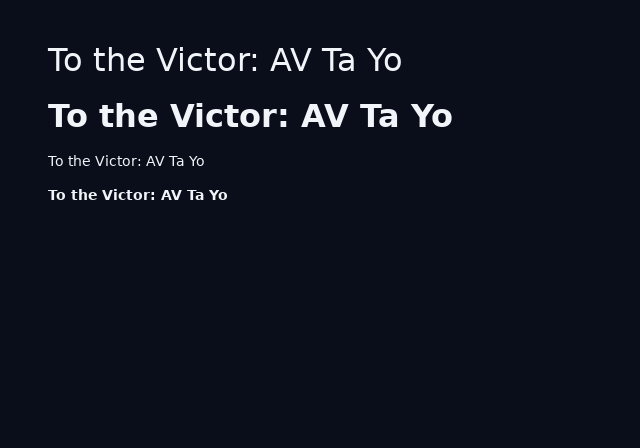
The T/o and A/V pairs close up at 32px. At 14px the same kerns round to zero.
Minimal example
fonts/fonts.json in this repository:
{
  "regular": {
    "ttf": [
      "/usr/share/fonts/truetype/dejavu/DejaVuSans.ttf",
      "/usr/share/fonts/TTF/DejaVuSans.ttf",
      "/opt/homebrew/share/fonts/DejaVuSans.ttf",
      "/Library/Fonts/DejaVuSans.ttf",
      "/usr/local/share/fonts/DejaVuSans.ttf",
      "~/Library/Fonts/DejaVuSans.ttf",
      "C:/Windows/Fonts/DejaVuSans.ttf",
      "~/AppData/Local/Microsoft/Windows/Fonts/DejaVuSans.ttf",
      "vendor/DejaVuSans.ttf"
    ],
    "metrics": "default.metrics.json"
  },
  "bold": {
    "ttf": [ "..." ],
    "metrics": "default-bold.metrics.json"
  }
}
ttf is a candidate list and the first path that exists wins. ~ expands before the absolute test. A relative candidate resolves against the manifest's own directory. A candidate for a platform you are not on costs nothing and is never a mistake: os.path.isabs("C:/Windows/Fonts/DejaVuSans.ttf") is False on POSIX, so it is joined to the manifest's directory, does not exist, and the loop moves to the next one, which is the same outcome as an absolute path that is absent. Pass the file to both tools:
ps2ui-layout ui/library.html ui/library.css --fonts fonts/fonts.json -o build/library.json
ps2ui-bake build/library.json --fonts fonts/fonts.json -o build/ui.uib
--font-dir DIR is the other spelling. It takes a directory holding default.metrics.json and default-bold.metrics.json under exactly those names.
Reference table
Fields of a metrics JSON, from build_metrics in fontgen.py:
| field | type | meaning |
|---|---|---|
family |
string | Family name passed to ps2ui-fontgen. |
weight |
integer | CSS weight this face stands for. |
unitsPerEm |
integer | Always 1000. The face is loaded at a 1000px em. |
ascent |
integer | Ascent in units, from the TTF at that em. |
descent |
integer | Descent in units, positive. |
advances |
object | Decimal codepoint string to integer units. |
kerning |
object | "prev,cur" codepoint pair to integer units, sparse and directional. |
missing |
integer | Advance for a codepoint absent from advances. |
source |
string | File name of the TTF it was generated from. |
CSS properties the pen reads. Values and defaults are on the CSS page.
| property | effect on the pen |
|---|---|
font-size |
Scales every advance and every kern. |
font-weight |
Picks the face. 600 and above is bold. |
letter-spacing |
Adds pixels at each junction between two glyphs. |
line-height |
Sets the line box height and the half-leading. |
white-space |
nowrap skips wrapping and measures the string whole. |
text-overflow |
ellipsis truncates an overflowing nowrap line. |
text-align |
Shifts a placed line inside the content box. |
Behaviour
Faces and weights
There is no weight axis. font-weight selects one of two faces, and 600 is the boundary. Compile four weights in a row and read the pen positions back:
ps2ui-layout weights.html weights.css --fonts fonts/fonts.json -o weights.json
python3 -c "
import json
for c in json.load(open('weights.json'))['commands']:
    if c['op']=='text': print('weight %3d  x=%d' % (c['weight'], c['x']))
"
Each box holds Ta at 32px. The 500 and 599 boxes are 35px wide, the 600 box is 40px wide. The IR carries the CSS number, not the face name; the compiler and the baker each apply the same 600 test.
The charset
The shipped metrics carry 115 codepoints. Print them from the committed file:
python3 -c "
import json
cps = sorted(int(k) for k in json.load(open('fonts/default.metrics.json'))['advances'])
print(len(cps), 'codepoints,', sum(1 for c in cps if 32 <= c <= 126), 'of them 32 to 126')
print(' '.join('U+%04X %s' % (c, chr(c)) for c in cps if c > 126))
"
115 codepoints, 95 of them 32 to 126
U+00A0   U+00B7 · U+00D7 × U+2013 – U+2014 — U+2018 ‘ U+2019 ’ U+201C “ U+201D ” U+2026 … U+2190 ← U+2191 ↑ U+2192 → U+2193 ↓ U+25A1 □ U+25B3 △ U+25C7 ◇ U+25CB ○ U+2713 ✓ U+2715 ✕
A codepoint outside that set takes the missing advance, which is the advance of ?. Three pens then diverge in what they draw. The compiler only measures. The baker's atlas uses the ? advance and rasterizes the real character from the TTF. The runtime and the blob pen substitute the ? glyph, because the blob's font table has no entry. Extend the set with a charset file argument to ps2ui-fontgen.
Measuring and rounding
One rule governs both hosts:
floor(x + 0.5) is written out on both sides because Python's round() rounds half to even and JavaScript's Math.round does not. A kern rounds independently by the same rule, so a pen built from integral advances and integral kerns never lands on a half pixel.
python3 -c "
from ps2ui_bake.rounding import glyph_advance_px, kern_px
print('T advance at 32px:', glyph_advance_px(611, 32))
print('kern T,o at 32px: ', kern_px(-170, 32))
print('kern T,o at 11px: ', kern_px(-170, 11))
print('kern T,o at  8px: ', kern_px(-170, 8))
"
measure, wrapText and ellipsize all run one walk: kern before the glyph, record the position, then advance. Letter-spacing is a junction cost, so n glyphs carry n - 1 junctions and the first glyph has none.
A test runs both pens over nine strings, seven sizes and three letter-spacings and compares every glyph position:
cd packages/baker && python3 -m unittest discover -s tests -p test_baker.py -k TestCrossLanguagePen -v
test_the_comparison_would_notice_a_disagreement (test_baker.TestCrossLanguagePen.test_the_comparison_would_notice_a_disagreement) ... ok
test_the_two_pens_place_every_glyph_on_the_same_pixel (test_baker.TestCrossLanguagePen.test_the_two_pens_place_every_glyph_on_the_same_pixel) ... ok

----------------------------------------------------------------------
Ran 2 tests in 0.260s

OK
Kerning
Kerning is a property of the ordered pair. To kerns and oT does not. The table is sparse: only pairs whose rounded value is non-zero are stored.
Kerning is a sub-em adjustment, so it thins out as the size falls. The regular face carries 284 pairs; 161 of them are non-zero at 14px and 123 are not. Rounding is asymmetric about zero, so a tie under-applies a negative kern. Text then comes out a pixel wider than ideal rather than narrower, and the measured box is never smaller than what is drawn in it.
Wrapping
Break opportunities are spaces only. CJK line breaking does not exist here. The charset lint rule reports the first codepoint above U+24FF in a run:
A word wider than the box is not broken. It becomes its own overflowing line, and the box keeps the wider width.
The width a line accumulates while wrapping equals measure() of the same line. The join cost is the space's own advance, both kerns the space makes with its neighbours, and two letter-spacings.
Ellipsis
text-overflow: ellipsis applies only alongside white-space: nowrap. Both are tested together. Compile one box with each:
.screen { flex-direction: column; }
.clip, .ell { width: 100px; font-size: 14px; text-overflow: ellipsis; }
.ell { white-space: nowrap; }
The .clip box wrapped to two lines and kept its text. The .ell box truncated. The … is measured attached to the candidate prefix, because it kerns against whatever glyph the cut leaves last. A trailing space before the … is stripped.
Line height and baseline
line-height accepts a px length, a unitless multiplier and a per cent. A per cent is stored as the multiplier value / 100. All three resolve to integral pixels. At font-size: 16px, the three forms below produce the same 24px step:
A text command's y is the line top plus floor(leading / 2), where leading is the line height minus the ascent and descent in pixels. At 16px the ascent is 15px and the descent 4px, so a 24px line box leaves 5px of leading and the first line starts at 2.
Regenerating the metrics
The metrics are committed so a contributor with no TTF gets identical advances. One command rebuilds them:
regen: regular = /usr/share/fonts/truetype/dejavu/DejaVuSans.ttf
ps2ui-fontgen: 115 glyphs, 284 kern pairs -> /home/user/OPHTML/fonts/default.metrics.json
regen: bold = /usr/share/fonts/truetype/dejavu/DejaVuSans-Bold.ttf
ps2ui-fontgen: 115 glyphs, 163 kern pairs -> /home/user/OPHTML/fonts/default-bold.metrics.json
git diff --exit-code fonts/ after that run exited 0. The script resolves its TTFs through fonts.json, so the metrics come from the file the build rasterizes.
Limits and errors
| message | cause | fix |
|---|---|---|
no font metrics at <path> |
--font-dir names a directory without both fixed file names. |
Generate both files, or pass --fonts fonts.json. |
<path>: no "regular" face with a "metrics" path |
A manifest face is absent or has no metrics key. |
Add the key. The message names the ps2ui-fontgen argv. |
<path>: cannot be read as a fonts.json manifest (...) |
The manifest is missing or is not JSON. | Fix the file. |
fonts.json: no candidate TTF for '<face>' exists: [...] |
No ttf candidate resolves, at bake time. |
Add the path your machine uses to the list. |
layout: data-slot "<n>" placeholder wraps to <k> lines |
A slot placeholder does not fit on one line. | Add white-space: nowrap, or widen the box. |
Further limits:
| limit | detail |
|---|---|
| Two faces | font-weight buckets at 600. No other weight exists. |
| 115 glyphs | Anything else measures as ? until the charset is extended. |
| Spaces only | No hyphenation, no CJK breaking, no soft hyphen. |
~ in metrics |
The baker expands it, the compiler does not. A manifest using ~ for a metrics path loads in ps2ui-bake and fails in ps2ui-layout with an ENOENT naming a literal ~ directory. |
| Checked keywords | New in 0.7.0. white-space takes normal or nowrap and text-overflow takes clip or ellipsis; anything else is an error. pre and its relatives are named as real CSS this target does not implement. Before it, any other value behaved as the default. |
Related pages
- ps2ui-fontgen generates a metrics JSON and a
fonts.json. - CSS lists every text property, its values and its default.
- Dynamic text covers slot text, which walks this pen at runtime.