Video modes
What it is
A video mode fixes two separate things. The framebuffer is the pixel grid the compiler lays out in. The panel is the shape the television draws that grid at. MODES in aspect.js pairs them into four presets.
Select one with --mode on ps2ui-layout, or with the mode key in the project file. The pair reaches the blob header, so the runtime can report the aspect the UI was authored for.
PS2 widescreen is anamorphic. ntsc16x9 keeps the same 640x448 framebuffer as ntsc and asks the panel to stretch it sideways. Every authored pixel then draws wider than it is tall. A square in CSS arrives on the television as a rectangle.
Minimal example
Name the mode once, in ps2ui.json:
{
  "screens": ["ui/title.html"],
  "css": "ui/title.css",
  "mode": "ntsc16x9",
  "out": "build/ui.uib",
  "preview": "build/preview.png",
  "previewDisplay": "build/preview-display.png"
}
Build it:
ps2ui-layout: 2 paint commands, 0 focusables -> build/title.json
...
ps2ui-bake: 1 screen(s), 9 records, 1 textures (16 KiB baked), 1 CLUTs -> build/ui.uib
ps2ui-bake: arena 1066 bytes (static uint8_t arena[1066] __attribute__((aligned(16))))
ps2ui-bake: preview -> build/preview.png
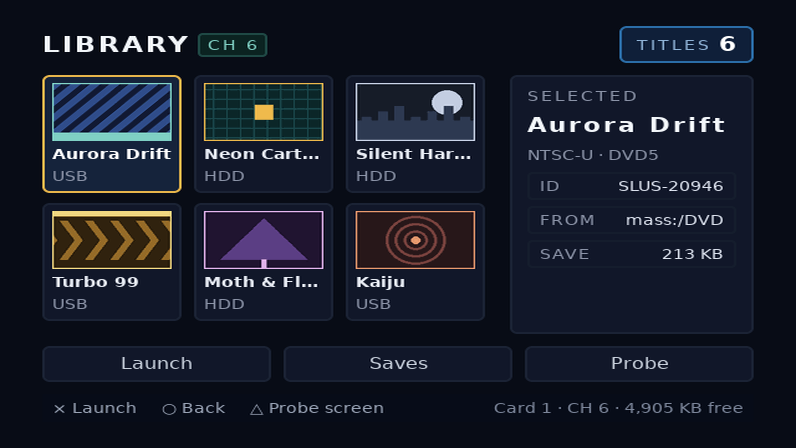
ps2ui-bake: display preview 796x448 at 16:9 -> build/preview-display.png
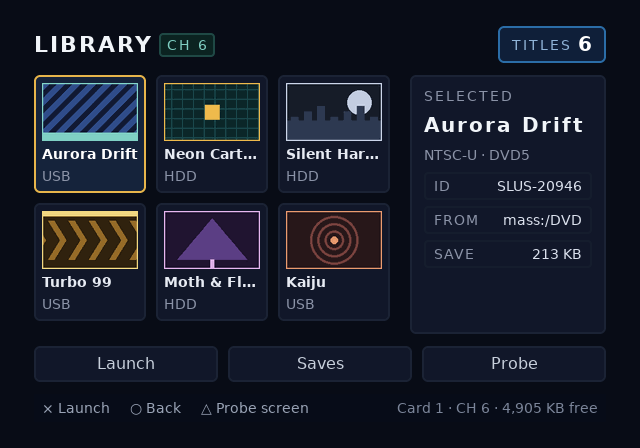
build/preview.png is 640x448, the framebuffer. build/preview-display.png is 796x448, the panel.
Reference table
Framebuffer is the canvas the compiler lays out in. Panel is the aspect the television draws it at. PAR is the pixel aspect ratio, above 1.0 when pixels draw wider than tall.
| mode | framebuffer | panel | PAR |
|---|---|---|---|
ntsc |
640x448 | 4:3 | 0.9333 |
ntsc16x9 |
640x448 | 16:9 | 1.2444 |
pal |
640x512 | 4:3 | 1.0667 |
pal16x9 |
640x512 | 16:9 | 1.4222 |
Each row comes from compiling the channel6 games screen under that mode and reading ir.canvas:
Three flags decide the pair, and two of them override the third.
| flag | effect |
|---|---|
--mode ntsc\|ntsc16x9\|pal\|pal16x9 |
sets framebuffer size and panel aspect together, from the table above |
--canvas WxH |
replaces the framebuffer size, keeping the panel aspect |
--display-aspect W:H |
replaces the panel aspect, keeping the framebuffer size |
Argument order does not matter. The bin applies --mode first and the two overrides afterwards, at ps2ui-layout.js.
ps2ui-layout channel6/ui/games.html channel6/ui/channel6.css -o out/c1.json --mode pal --canvas 704x448
The same three names are project keys, spelled mode, canvas and displayAspect. ps2ui build carries an override for --mode only.
Behaviour
Anamorphic pixels
PAR is displayAspect / (canvasW / canvasH), at aspect.js. The 4:3 modes are not square-pixel either, so no mode draws a CSS square as a square.
The IR carries the exact ratio, the derived PAR and the panel size. The panel size takes height as authoritative, because anamorphic stretching is horizontal.
Changing the panel aspect changes no pixel the compiler emits. The 1:1 render of the channel6 16:9 blob is byte-identical to the 4:3 one:
That command prints nothing and exits 0. What the mode changes is the header, the lint warnings and the panel-aspect preview.
Previewing at the panel's aspect
--preview on ps2ui-bake writes framebuffer pixels. Compare that PNG against a framebuffer capture. Here is the channel6 16:9 blob at 1:1.
--preview-display resamples that render to the panel size and prints what it wrote. Compare this PNG against a photograph of the television.
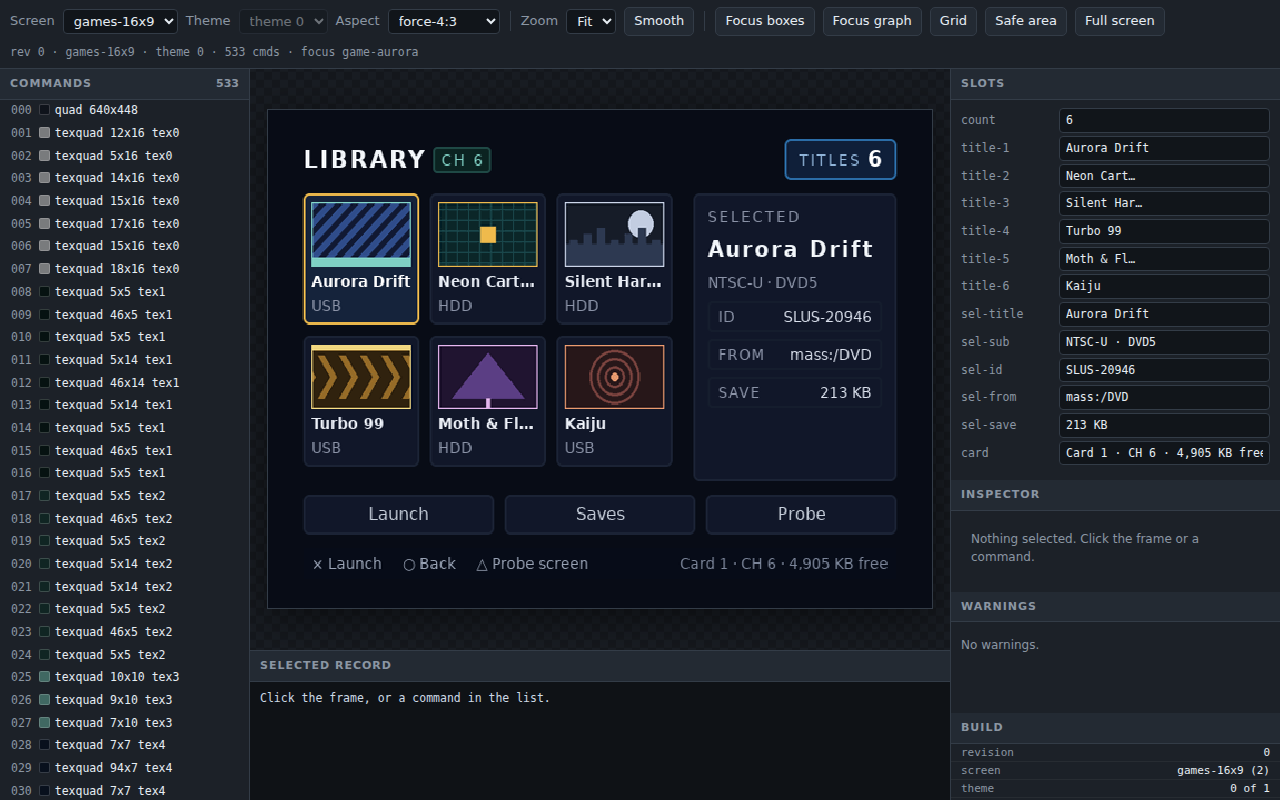
ps2ui serve offers the same choice live, in the Aspect menu.
| aspect mode | what the frame shows |
|---|---|
framebuffer |
the render at 1:1, canvas size |
authored |
the blob's own aspect, the default |
force-4:3 |
the render resized to 4:3, whatever the blob says |
force-16:9 |
the render resized to 16:9, whatever the blob says |
Forcing is the mismatch check. A 16:9 screen forced to 4:3 shows what a console left in 4:3 does to it.
The distortion lint
aspect-distortion checks the document once, when PAR leaves 1.0 by more than 0.08. It emits one warning for rounded corners and one for images, each only when that kind is present. See the CRT linter for the rule beside the others. Both 4:3 modes stay under the threshold and stay quiet.
warning: aspect-distortion: 24 rounded corner(s) draw 24% wider than tall at PAR 1.2444; divide the radius by 1.244 to look round
warning: aspect-distortion: 6 image(s) draw 24% wider than tall at PAR 1.2444; pre-squash the art or set an explicit width
ps2ui-layout: 90 paint commands, 9 focusables -> out/ntsc16x9.json
Geometry is frozen at bake time, so the fix is authoring. Divide a radius by the PAR to get a corner that reads as round. Pre-squash art, or give an image an explicit width.
The header field
The header holds the ratio as two integers, display_aspect_num and display_aspect_den, at ps2ui.h. ps2ui-check prints it in its summary line.
...
# examples/channel6/build/ui-16x9.uib: 640x448 at 16:9, 2 screen(s), 1242 commands, 25 textures, 15 slots
PASS: 75 checks, 0 error(s), 1 warning(s)
ps2ui_pixel_aspect_x1000 derives the PAR from those fields in integer arithmetic. Loading one blob per mode and calling it returns 933, 1244, 1066 and 1422. The runtime draws in framebuffer pixels whatever the answer. Use the value to check the video mode the app set, as in first boot, step 10.
PAL
PAL is a taller framebuffer, 640x512, so its PAR differs from NTSC at the same panel aspect. The linter derives its title-safe inset from the canvas, at 5% per side. That is 32 by 22 pixels at 640x448 and 32 by 26 at 640x512.
The same text therefore passes one canvas and fails the other. This screen puts 20px text at (40,24):
.screen { flex-direction: column; background: #060a14; padding: 24px 40px; }
.head { font-size: 20px; color: #e8eefc; }
At --canvas 640x448 it compiles silently. At --canvas 640x512 the inset grows to 26 and the text falls outside it:
warning: overscan: text "CHANNEL 6" at (40,24) leaves the title-safe area; a CRT may crop it
ps2ui-layout: 2 paint commands, 0 focusables -> out/i512.json
Limits and errors
One blob carries one video mode. Every IR in a bake must agree on canvas and aspect, or the flattener refuses before anything is written.
...
ps2ui-bake: screen 'probe-16x9': canvas {'w': 640, 'h': 448, 'displayAspect': [16, 9], 'par': 1.2444, 'display': {'w': 796, 'h': 448}} differs from {'w': 640, 'h': 448, 'displayAspect': [4, 3], 'par': 0.9333, 'display': {'w': 597, 'h': 448}} — all screens share one video mode
A second aspect is a second build. ps2ui build --mode ntsc16x9 -o build/ui-16x9.uib moves the intermediates with the blob, which renames the screens inside it. The 16:9 channel6 blob holds games-16x9 and probe-16x9, not games and probe. Pass the suffixed name to ps2ui_screen_set and to the previewer.
An unknown mode reaches ps2ui-layout unchecked by the project loader. It prints the usage line and ps2ui build exits 1. A malformed --display-aspect is worse: it escapes the argument loop and prints a stack trace, see ps2ui-layout exit codes.
Square pixels at 16:9 need a wider framebuffer, --canvas 796x448 --display-aspect 16:9, which compiles to PAR 1.0006 and no distortion warning. The default VRAM budget does not survive it.
...
  framebuffers assumed: 2x draw/display + 1x Z @ 796x448 = 4472832 B
  the default budget does not exist at this canvas: three framebuffers at 796x448 need 4472832 B of 4194304 B total VRAM, so there is nothing left to charge textures against and an empty blob would fail here
...
error: texture VRAM footprint exceeds budget (see breakdown above; override with --vram-budget)
Declare vramBudget for the layout actually running. With Z buffering off the console holds two framebuffers, which left 1212416 B for the same blob and baked it clean.
Related pages
| page | why |
|---|---|
| ps2ui-layout | every flag, including --mode, --canvas and --display-aspect |
| ps2ui-bake | --preview-display and the rest of the bake transcript |
| The CRT linter | aspect-distortion beside the other rules and their thresholds |
| Previewer | the Aspect menu and the inspector's pixel aspect readout |
| C API reference | ps2ui_pixel_aspect_x1000 and the other queries |
| First boot | checking the console's video mode against the blob |
| The project file | mode, canvas, displayAspect and vramBudget |
| VRAM budget | what a wider framebuffer costs |