Focus and navigation
The console has a D-pad and no pointer. Mark the elements a person can land on, and the compiler solves where every direction leads, once, at build time.
What it is
An element carrying focusable becomes one focus node. The node holds the element's laid-out rectangle, a name, and four neighbour ids. ps2ui-layout solves the four neighbours for every node by comparing rectangles, writes them into the IR, and the baker copies them into the blob.
The runtime never measures anything. ps2ui_move reads one field of one struct and assigns an index. That is the whole of D-pad navigation at runtime.
Focus is also a paint state. A :focus rule on a focusable element compiles to a second command, paired with the unfocused one. The border below changes colour without a second layout pass. See CSS for the paint side.
Minimal example
Three tiles in a row. The first carries autofocus.
<div class="page">
  <div class="row">
    <div class="tile" id="tile-ico" focusable autofocus>Ico</div>
    <div class="tile" id="tile-sotc" focusable>Shadow of the Colossus</div>
    <div class="tile" id="tile-gt4" focusable>Gran Turismo 4</div>
  </div>
</div>
.page { width: 640px; height: 448px; background: #10141f; padding: 64px }
.row { display: flex; flex-direction: row; gap: 24px }
.tile { width: 160px; height: 160px; background: #1b2233; color: #e8ecf4; font-size: 18px; border-width: 2px; border-color: #1b2233 }
.tile:focus { background: #22304a; border-color: #e3b341 }
Read the solved graph back out of the IR. Save this as edges.js; the blocks below reuse it.
const { resolve } = require('path');
const ir = require(resolve(process.argv[2]));
const by = Object.fromEntries(ir.focus.nodes.map((n) => [n.id, n.name]));
const f = (v) => (v === null ? '-' : by[v]);
for (const n of ir.focus.nodes) {
  console.log(`${n.name}  up=${f(n.up)} down=${f(n.down)} left=${f(n.left)} right=${f(n.right)}`);
}
tile-ico  up=- down=- left=- right=tile-sotc
tile-sotc  up=- down=- left=tile-ico right=tile-gt4
tile-gt4  up=- down=- left=tile-sotc right=-
ir.focus.initial is 3, the box id of tile-ico.
Reference table
| attribute | element | effect | page |
|---|---|---|---|
focusable |
any | Adds one focus node and opens a focus scope. Presence only, so focusable="false" is focusable. |
HTML |
autofocus |
any focusable element | Makes that node the screen's initial focus. Presence only. | HTML |
id |
any focusable element | Names the focus node. Wins over name. |
HTML |
name |
any focusable element | Names the focus node when the element carries no id. |
HTML |
| flag | argument | default | effect |
|---|---|---|---|
--focus-wrap |
none | off | Fills the edges the solver left empty with wrap-around edges. See ps2ui-layout. |
A project file sets the same thing per screen with focusWrap. See the project file.
| signature | returns | scope | notes |
|---|---|---|---|
int ps2ui_move(ps2ui_ctx*, ps2ui_dir) |
1 when focus changed, else 0 | current screen | Follows one graph edge. Skips hidden nodes. |
const char *ps2ui_focus_name(const ps2ui_ctx*) |
the focused node's name, or NULL | current screen | The name the HTML chose. |
int ps2ui_focus_set(ps2ui_ctx*, const char *name) |
1, or 0 for an unknown name | current screen | Reaches hidden nodes. |
Full signatures and the ps2ui_dir enum are on the C API reference.
Behaviour
The solver
For one node and one direction, findTarget walks every other node on the screen and keeps the best. Five rules decide it.
- A candidate qualifies only when its centre is strictly beyond the current centre on the pressed axis.
- A candidate whose perpendicular extent overlaps the moving box's is "in the beam".
- In-beam candidates beat every out-of-beam candidate.
- Among equals, the lowest
along + 2 * perpwins, wherealongis the centre distance along the pressed axis andperpthe centre distance across it. - A remaining tie goes to the lower box id, which is document order.
Rule 4 is why pressing right prefers a same-row tile slightly further away over a nearer diagonal one. A direction with no qualifying candidate is null.
A 3-wide by 2-tall grid of 144x120 tiles, tiles a to f in document order:
a  up=- down=d left=- right=b
b  up=- down=e left=a right=c
c  up=- down=f left=b right=-
d  up=a down=- left=- right=e
e  up=b down=- left=d right=f
f  up=c down=- left=e right=-
a goes down to d, never to the diagonal e, because d is in the beam and e is not.
Wrap
--focus-wrap runs a second pass over the empty edges only. It takes the farthest candidate that is in the beam and sits on the opposite side of the pressed direction. Pressing right off a row's last tile lands on that row's first tile.
ps2ui-layout grid.html grid.css --fonts fonts/fonts.json --focus-wrap -o grid-wrap.json
node edges.js grid-wrap.json
a  up=d down=d left=c right=b
b  up=e down=e left=a right=c
c  up=f down=f left=b right=a
d  up=a down=a left=f right=e
e  up=b down=b left=d right=f
f  up=c down=c left=e right=d
All eight empty edges filled. None of the sixteen solved edges moved. In a two-row grid the wrapped up and the solved down land on the same node, which the a row above shows.
Names
A node's name is the element's id. With no id, it is the name attribute. With neither, it is box followed by the compiler's internal box id, which changes when the markup above it changes. Name every focusable the app talks about.
Initial focus
The first focusable carrying autofocus, in document order, is the screen's initial focus. With no autofocus, it is the first focusable. A second autofocus is accepted in silence and loses to the first.
Screens
Focus is per screen. Each screen entry in the blob carries focus_first, focus_count and its own initial node. The baker appends each screen's nodes in order. It then rewrites every edge from the screen-local id to the global index, so no edge points outside its screen.
The memcard example builds two screens that both name a node nav-games:
PYTHONPATH=packages/baker python3 -c "
from ps2ui_bake.uib import read_uib
b = read_uib('examples/memcard/build/ui.uib')
for s in b.screens: print(s['name'], s['focus_first'], s['focus_count'], s['initial'])
print(b.focus[0]['name'], b.focus[9]['name'])"
ps2ui_focus_set and ps2ui_visible_set resolve a name inside the current screen's range, so naming the other screen's node fails rather than reaching it.
Hidden nodes
ps2ui_move walks past a hidden node in the same direction instead of landing on it. When every candidate in that direction is hidden it returns 0 and focus stays put. ps2ui_focus_set is deliberate and still reaches a hidden node. See Moving and hiding.
Seeing the graph
The previewer draws one arrow per solved edge. Press n or click Focus graph.
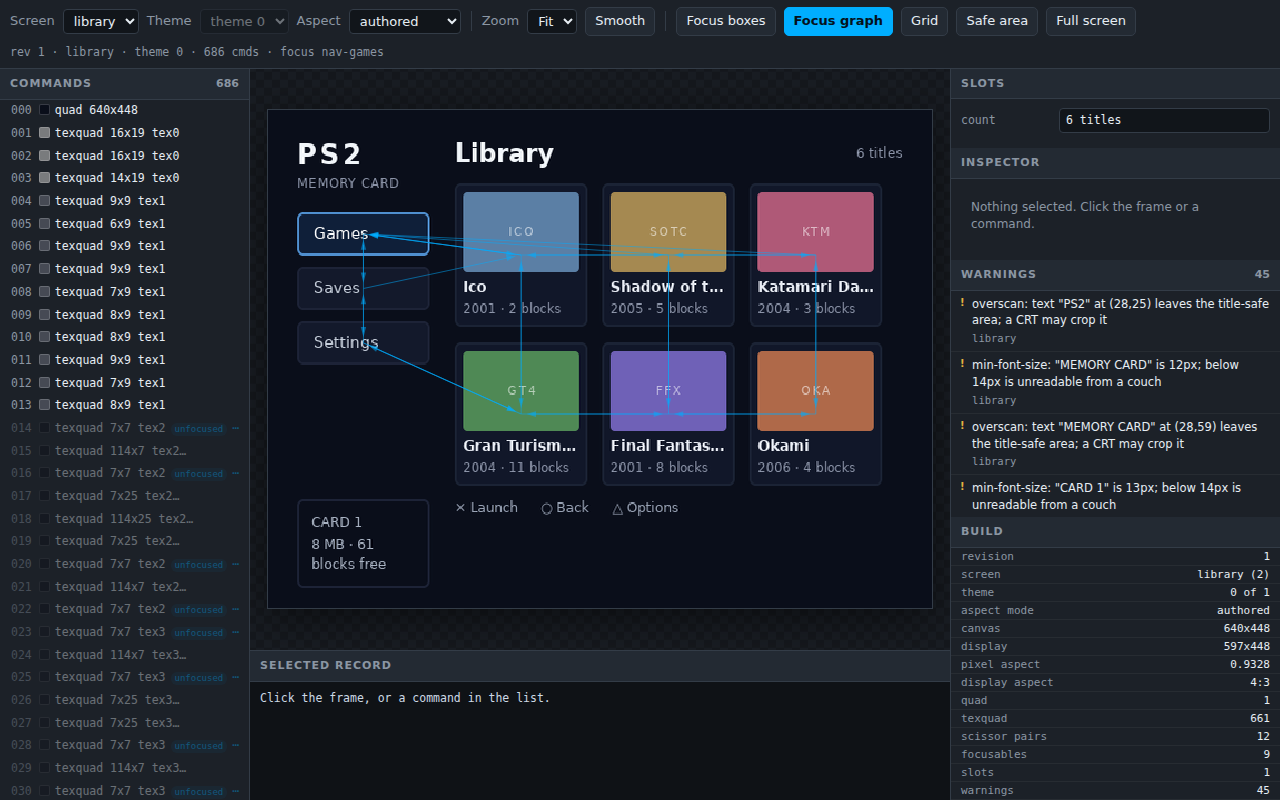
preview.montage renders one canvas per focusable of a screen with that node focused. The library screen has nine.
PYTHONPATH=packages/baker python3 -c "
from ps2ui_bake.uib import read_uib
from ps2ui_bake import preview
preview.montage(read_uib('examples/memcard/build/ui.uib')).save(
    'docs/site/assets/authoring/focus-and-navigation/states.png')"
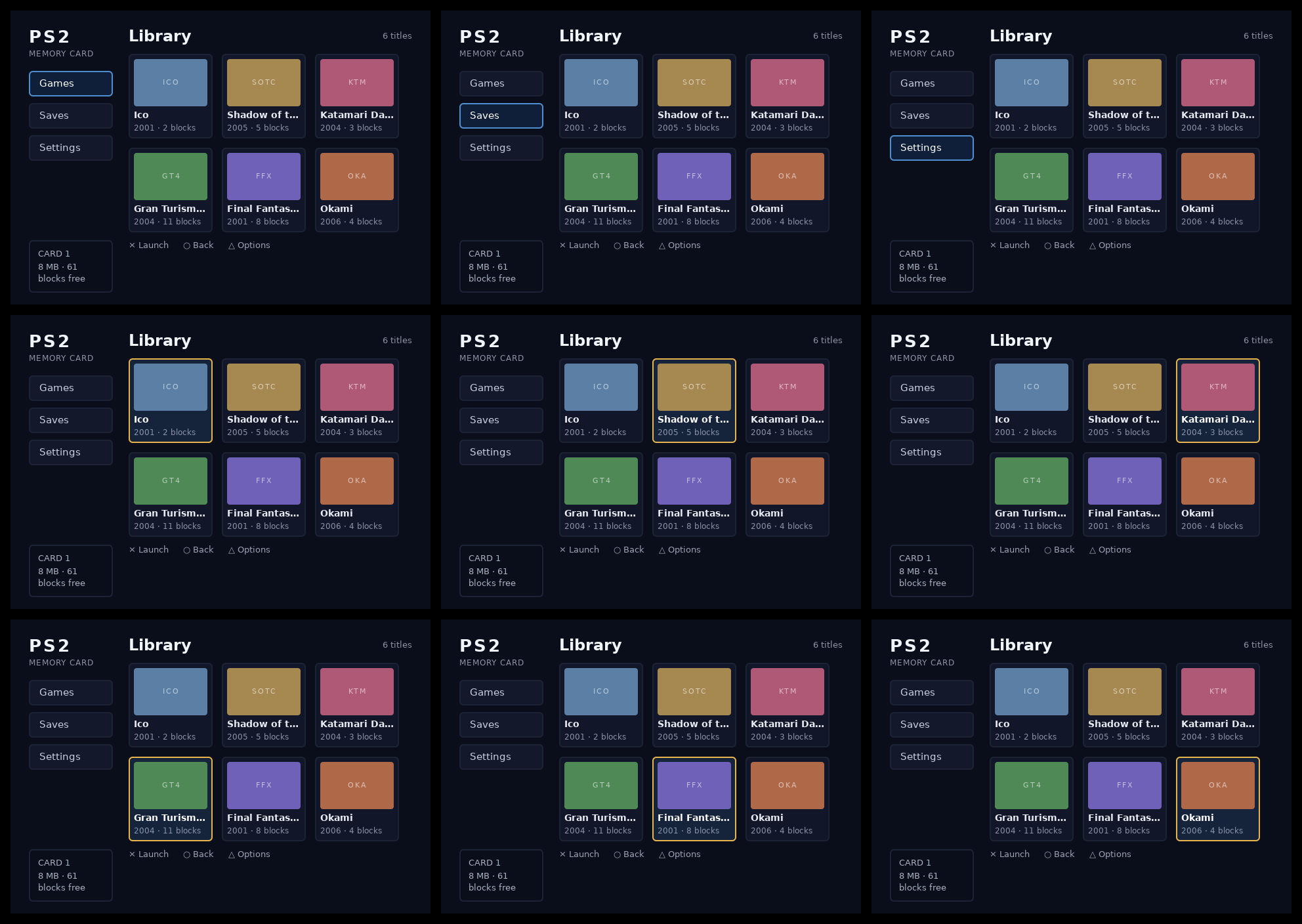
More on both under the previewer.
Limits and errors
| message | stage | severity | cause | fix | page |
|---|---|---|---|---|---|
layout: <tag> line N: nested focusable inside another focusable — the D-pad model has one focus ring; flatten the hierarchy. |
layout | error, exit 1 | focusable inside another focusable's subtree |
Move the inner focusable out, or drop it and style the child from the parent's :focus rule |
Diagnostics |
focus: "<name>" is unreachable from the initial focus by D-pad |
layout | warning, exit 0 | No chain of edges reaches the node from the initial focus | Move the node so a neighbour can see it, or add --focus-wrap |
Diagnostics |
<screen>: every focusable reachable by D-pad |
check | error, exit 1 | The same walk, re-run over the blob | As above, then rebuild | ps2ui-check |
<screen>: no D-pad edge leaves the screen |
check | error, exit 1 | An edge points outside the screen's focus range | Report it; the baker remaps every edge, so a failure here means a malformed blob | ps2ui-check |
A nested focusable:
error: layout: <div> line 3: nested focusable inside another focusable — the D-pad model has one focus ring; flatten the hierarchy.
An unreachable node, here a second focusable stacked exactly on the first:
warning: focus: "over-tile" is unreachable from the initial focus by D-pad
ps2ui-layout: 5 paint commands, 2 focusables -> island.json
Exit stays 0. Add --strict to make it fail:
warning: focus: "over-tile" is unreachable from the initial focus by D-pad
ps2ui-layout: 5 paint commands, 2 focusables -> island.json
ps2ui-layout: --strict: 1 warning(s)
A :focus rule still only matches an element that carries focusable, but since 0.7.0 it no longer does so in silence. When the missing attribute is the only reason the rule did not match, the compiler warns and names the selector, so a forgotten focusable and a typo in the class name no longer look the same:
warning: css: line 3: ".panel:focus" matches <div> line 1, but no element in that
selector has the focusable attribute, so the :focus delta can never show. Add
focusable, or drop the :focus.
Three more limits have no diagnostic behind them.
- Focus names are unique per screen by convention. Two focusables with the same
idon one screen compile without a warning.ps2ui-checkdoes not test for it, and the runtime's lookup returns the first match. - The graph is solved against the baked layout. Nothing re-solves it at runtime, so hiding a node changes which nodes are reachable, not which edges exist.
--focus-wrapis a compile-time flag. Wrap edges are ordinary edges in the blob, indistinguishable from solved ones.
Related pages
- HTML for every attribute the compiler reads.
- ps2ui-layout for
--focus-wrapand--strict. - The project file for
focusWrap. - C API reference for the calls.
- Moving and hiding for hidden nodes.
- Previewer for the focus graph overlay.
- The frame loop for the activation convention.