Lists
A list is two halves. data-repeat bakes a fixed number of rows at compile time. ps2ui_list scrolls any number of items through those rows at runtime.
What it is
The row count belongs to the markup. The item count belongs to the data, and there is no data at build time. data-repeat="6" stamps six copies of one row into the document. The runtime then maps item top + r onto row r, and hides the rows past the end of the data.
Expansion happens on the element tree, before any style is computed. A repeated row compiles to exactly the commands a typed-out row compiles to. Nothing downstream can tell a copy from an original.
Six rows cost six focus nodes and six copies of the row's paint commands. That cost is the same whether the app has three items or three hundred.
Minimal example
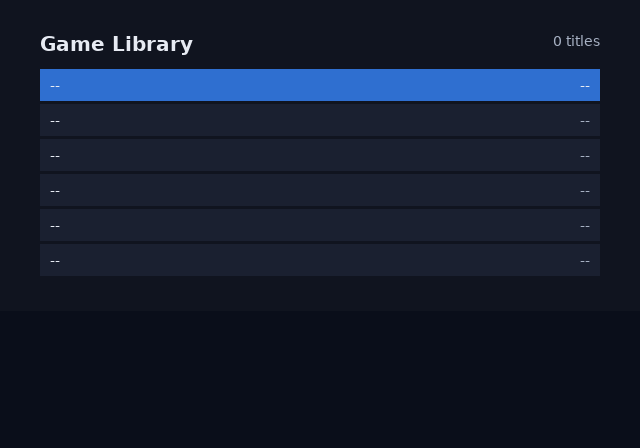
The screen below is the tutorial's library.html. One row carries data-repeat="6", an id with {i} in it, and two slots.
<screen name="library">
  <div class="page">
    <div class="header">
      <span class="title">Game Library</span>
      <span class="count" data-slot="count" data-slot-capacity="16">0 titles</span>
    </div>
    <div class="row" data-repeat="6" id="row-{i}" focusable>
      <span class="name" data-slot="name-{i}" data-slot-capacity="40">--</span>
      <span class="size" data-slot="size-{i}" data-slot-capacity="12">--</span>
    </div>
  </div>
</screen>
Build the project that holds it.
ps2ui-layout: 14 paint commands, 6 focusables -> build/library.json
...
ps2ui-bake: 1 screen(s), 24 records, 2 textures (32 KiB baked), 1 CLUTs -> build/ui.uib
ps2ui-bake: arena 1516 bytes (static uint8_t arena[1516] __attribute__((aligned(16))))
That run wrote six focus nodes named row-0 to row-5, and thirteen slots. The runtime binds a list to those names and fills those slots. This is the loop from the tutorial.
ps2ui_list list;
ps2ui_list_init(&list, "row-", 6);           /* the six baked rows */
ps2ui_list_set_count(&ui, &list, n_games);   /* however many you found */

for (;;) {
    if (pad_down)  ps2ui_list_move(&ui, &list, +1);
    if (pad_up)    ps2ui_list_move(&ui, &list, -1);

    for (uint16_t r = 0; r < list.rows; r++) {
        int item = ps2ui_list_item_at(&list, r);
        char name[8];
        sprintf(name, "name-%u", r);
        ps2ui_slot_set(&ui, name, item < 0 ? "" : titles[item]);
    }
    ps2ui_slot_set(&ui, "count", count_text);
    ...
}
Add ps2ui_list_apply_visibility(&ui, &list) after the refill to hide the rows past the end, not only blank them.
Reference table
| attribute | rule |
|---|---|
data-repeat="N" |
Stamps N copies of the element into its parent, in place. |
| the count | A literal decimal from 1 to 256. It is baked, so it cannot come from data. |
{i} |
The 0-based copy index, substituted in every attribute value and text node of the subtree. |
{n} |
The 1-based copy index, substituted the same way. |
data-repeat on the root element |
Refused. The root has no parent to repeat into. |
data-repeat inside a data-repeat subtree |
Refused. Only one index is in scope. |
data-repeat in the cascade |
Never arrives. The expansion pass consumes the attribute. |
The seven list functions are also on the C API reference, with their scope column.
| signature | returns | notes |
|---|---|---|
void ps2ui_list_init(ps2ui_list *list, const char *prefix, uint16_t rows) |
none | Binds rows baked rows named prefix plus the row index. Stores the prefix pointer without copying it. |
void ps2ui_list_set_count(ps2ui_ctx *ctx, ps2ui_list *list, uint16_t count) |
none | Clamps sel and top into range and moves focus with them. A NULL ctx moves the indices only. |
int ps2ui_list_move(ps2ui_ctx *ctx, ps2ui_list *list, int delta) |
1 when sel or top changed, else 0 |
Clamps at both ends. Pass list->rows as the delta for a page. |
int ps2ui_list_select(ps2ui_ctx *ctx, ps2ui_list *list, uint16_t item) |
1 when sel or top changed, else 0 |
Absolute item index. An index at or past count clamps to the last item. |
int ps2ui_list_item_at(const ps2ui_list *list, uint16_t row) |
top + row, or -1 |
-1 past the last row and past the last item. This is the refill loop's test. |
int ps2ui_list_selected_row(const ps2ui_list *list) |
0 to rows minus 1, or -1 |
-1 for an empty list, and for a list bound to no rows. |
void ps2ui_list_apply_visibility(ps2ui_ctx *ctx, const ps2ui_list *list) |
none | Hides every row whose item_at is -1 and shows the rest, by row name. |
Behaviour
Expansion
The expansion pass runs before styles are computed, so the cascade sees N ordinary elements. Substitution rewrites attribute values and text nodes together. Give each copy a distinct id and distinct slot names, or the copies address the same thing. layout.test.js asserts that a repeated row and a typed-out row produce identical command lists.
A count above 1 with no {i} and no {n} anywhere in the subtree warns and compiles. The check reads descendant attributes too, so {i} on a nested data-slot alone is enough.
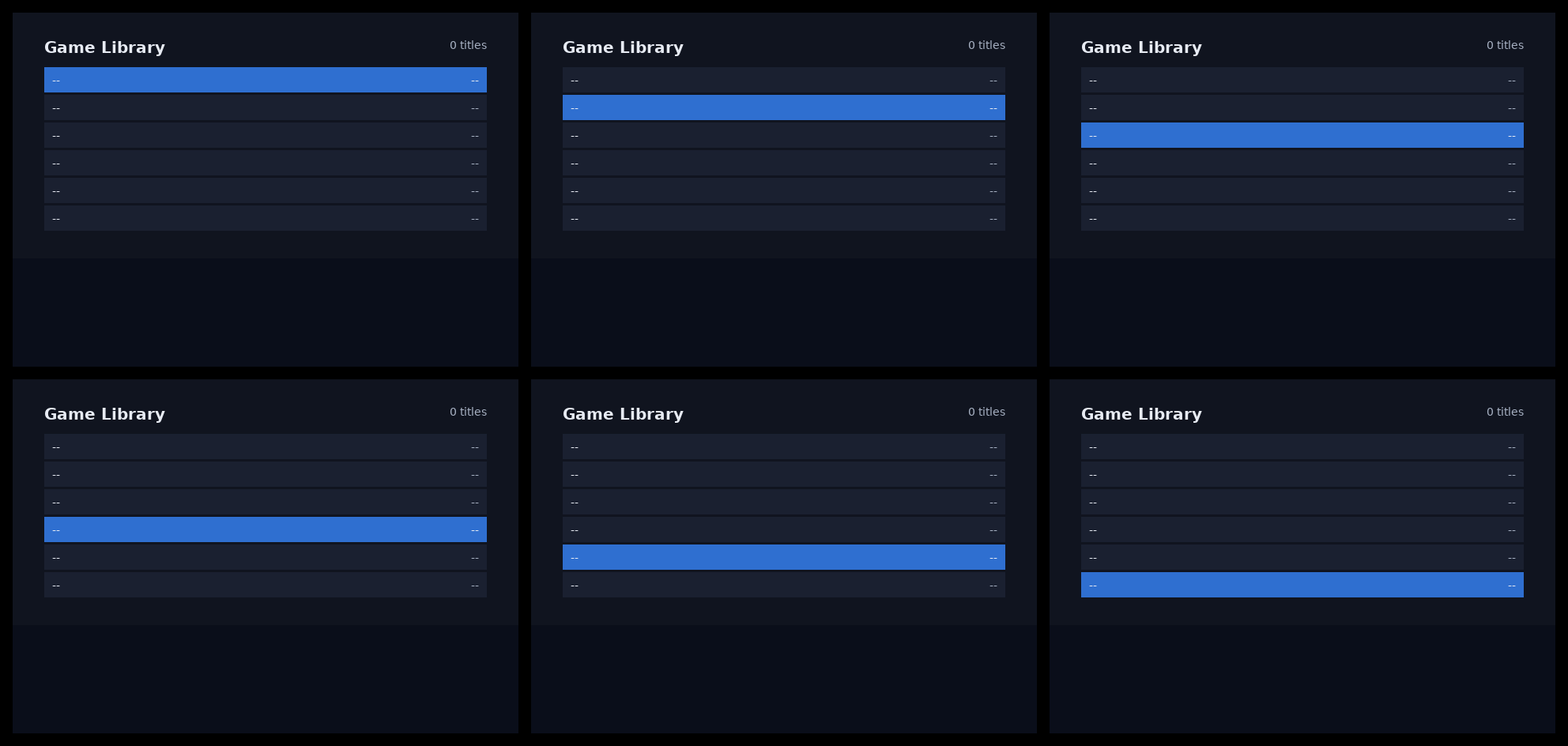
Every focus state of the six baked rows is in the montage below.
Runtime window
ps2ui_list holds five public fields: prefix, rows, count, top and sel. top is the item shown in row 0. sel is the selected item. The functions own top and sel, and the app reads them.
The window slides the minimum distance that puts sel back on screen. It never recentres. Moving down from the last visible row scrolls by one row, and the selection stays on the bottom row.
The window never wraps. Moving down on the last item returns 0, and so does moving up on the first.
When count is larger than rows, top stops at count minus rows. The last screenful is therefore full. When count is at most rows, top is 0.
Shrinking count under a selection that sat past the new end pulls both back into range. Setting count to 0 resets sel and top to 0.
Run the suite that proves each of those.
ok 138 - list starts empty
ok 139 - empty list has no item in row 0
ok 140 - empty list has no selected row
ok 141 - moving in an empty list does nothing
ok 142 - rows past the end of a short list report -1
ok 143 - long list starts at the top
ok 144 - selection reaches the last visible row without scrolling
ok 145 - the fifth step scrolls by exactly one row
ok 146 - the selection stays on the bottom row while scrolling
ok 147 - row 0 now shows item 1
ok 148 - moving past the end clamps
ok 149 - the last item is on the last row
ok 150 - moving down at the end is a no-op
ok 151 - moving past the start clamps
ok 152 - moving up at the start is a no-op
ok 153 - a page down moves one screenful
ok 154 - shrinking the list pulls the selection and window back in
ok 155 - emptying the list resets it
ok 156 - a prefix that matches no node still tracks indices
...
PASS: 410 checks, 0 failure(s)
Focus sync
Every index change rebuilds the selected row's focus name and calls ps2ui_focus_set. The name is the prefix followed by the decimal row index, so "row-" addresses row-0 upwards. Those names come from the id on the repeated element, described on Focus and navigation.
Row text is ordinary slot text. Refill it with ps2ui_slot_set after every move, as on Dynamic text.
Visibility
ps2ui_list_apply_visibility calls ps2ui_visible_set once per row. A hidden row takes its panel and its slot glyphs out of the frame. Call it after set_count and after any move. What hiding does to a frame is on Moving and hiding.
ok 297 - apply_visibility hides only the rows past the end
ok 298 - a short list draws less than a full one
ok 299 - shrinking a list never leaves focus on a hidden row
ok 300 - and focus follows the clamped selection
Limits and errors
Each row below stops the compile. ps2ui-layout prints the message on stderr with an error: prefix and exits 1.
| message | cause |
|---|---|
layout: <T> line N: data-repeat="R" is not a whole number. The count is baked, so it cannot come from data. |
The value does not match ^\d+$. |
layout: <T> line N: data-repeat="R" is out of range 1..256. Every copy costs commands, and a focusable one costs a focus node, so this is a budget you want to feel. |
The count is 0, or above 256. |
layout: <T> line N: data-repeat inside data-repeat. Only one index is in scope, so the inner {i} would be ambiguous. |
A repeated subtree holds another data-repeat. |
layout: <T> line N: data-repeat on the root element has nothing to repeat into; put it on a child |
The root element carries the attribute. |
layout: duplicate data-slot name "S" |
A data-slot under a repeat has no {i} in its name. |
error: layout: <div> line 2: data-repeat="300" is out of range 1..256. Every copy costs commands, and a focusable one costs a focus node, so this is a budget you want to feel.
One case warns and compiles.
warning: layout: <div> line 2: data-repeat="3" but no {i} or {n} anywhere inside, so every copy is identical. Add {i} to the ids and data-slot names, or the copies cannot be told apart.
...
ps2ui-layout: 7 paint commands, 0 focusables -> err/noindex.json
Three limits have no message at all.
A prefix that matches no baked focus name fails silently. The indices still move and ps2ui_list_move still returns 1, because the focus call's failure is discarded. Check ps2ui_focus_name against the row you expect during bring-up.
Nothing compares list->rows with the number of rows the blob actually carries. A rows larger than the blob has makes apply_visibility address names that do not resolve, and those calls do nothing.
Row names are built into a 64-byte stack buffer, PS2UI_LIST_NAME_MAX. A longer prefix is truncated, which then matches nothing.
Related pages
- HTML for the other twelve attributes the compiler reads.
- Dynamic text for slot names, capacity and truncation.
- Focus and navigation for how the six rows become a D-pad graph.
- Moving and hiding for visibility beyond a list.
- C API reference for the signatures and their scope.